Our story
History of the Central Medical Library
The Central Medical Library in Warsaw was established on 8 June 1945. Its creator and first director was Professor Stanisław Konopka (1896-1982). In establishing the Library, he realised his pre-war concept of the central library of the state. It fulfilled all the functions of a modern library, which by definition collected the complete Polish literature in the field of medicine and related sciences, as well as more important items of world literature.
She made them available, disseminated and documented them in published form:
- In the „Polish Medical Bibliography” (for the years 1945-1965)
- In the annually published central catalogue entitled „Directory of Periodicals and Continuing Publications of the Central Library of Medicine, Libraries of Academies and Universities of Medicine and Scientific Institutes”
In addition, it published the „Bulletin of the Central Medical Library” and the „Przegląd Piśmiennictwa Lekarskiego Polskiego”
Activities and achievements of Prof. Stanisław Konopka
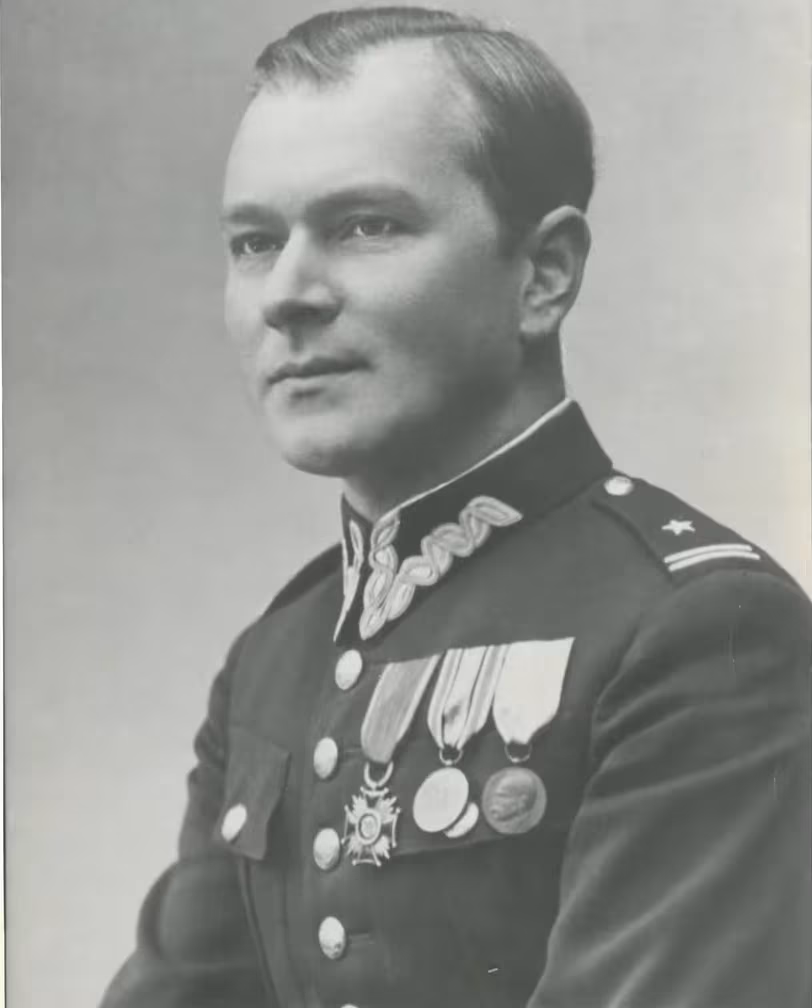
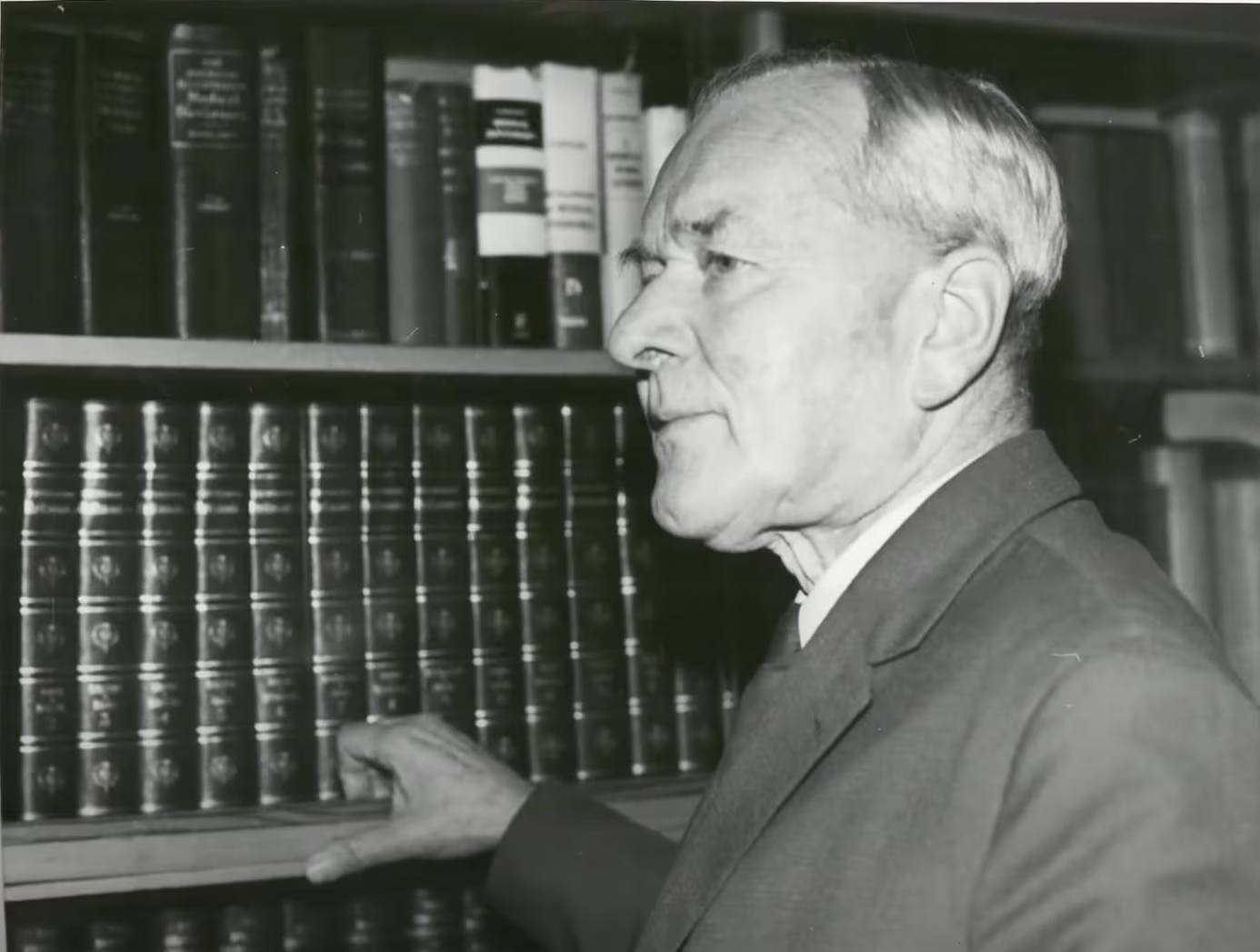
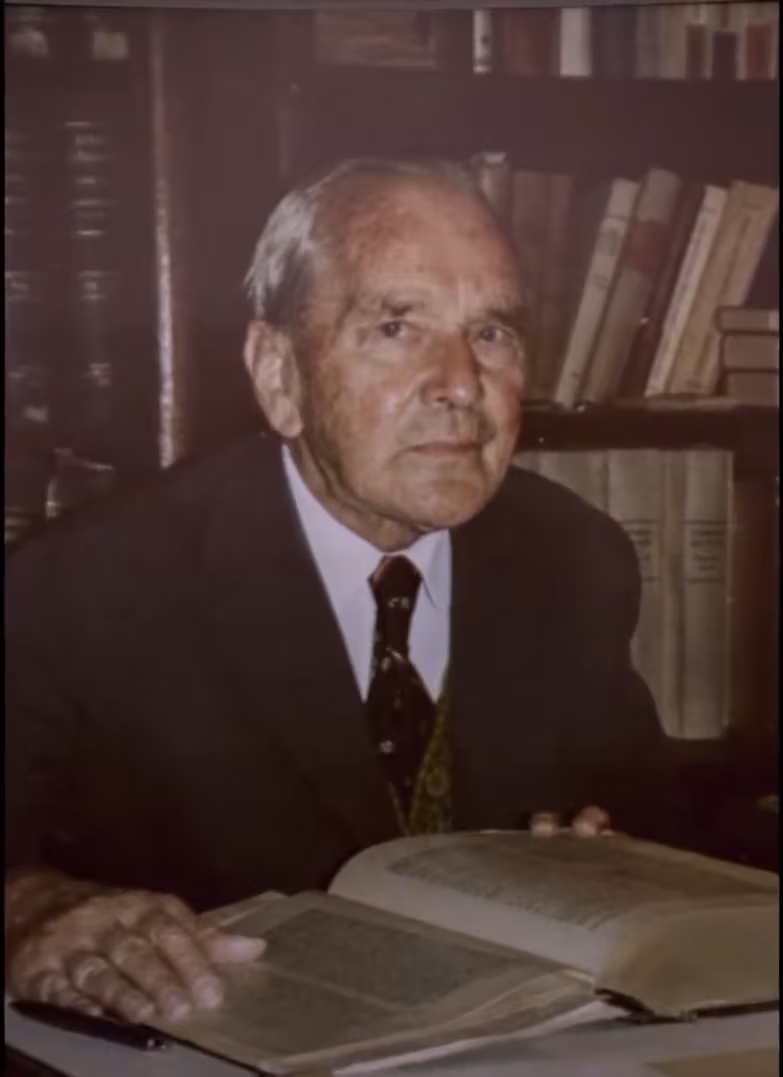
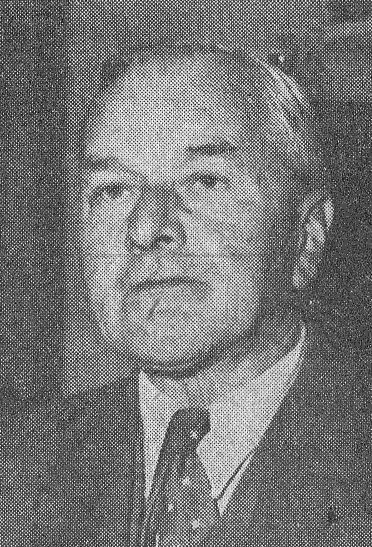
In his twenty-five years as director of the Main Medical Library, Prof. Stanisław Konopka created a modern organisational framework in which library and information activities were integrated. In particular:
- Acquired and expanded the GBL headquarters
- Established GBL Field Branches
- He created from scratch the richest medical book collection in Poland and one of the ten largest in the world
- He created the information service and its basic tool, the „Polish Medical Bibliography”
- Developed the „Dictionary of Headwords in Medicine and Related Sciences” for the subject development of both bibliographies and library catalogues for the entire network of medical libraries
On retiring, Professor Stanisław Konopka left behind a well-organised and well-equipped library of high national and international standing, with trained staff and a rich collection.
Development of scientific information and new technologies
The years of the second director, Prof. Feliks Widy-Wirski, were a period of using information technology in library-information and reprographic activities and applying it in practice. Prof. F. Widy-Wirski equipped the GBL with new library-information technologies and the only on-line connection in Poland with the American information system MEDLARS-MEDLINE via Karolinska Institutet in Stockholm. It was then that the Central Library of Medicine began to fulfil the tasks of a centre for scientific medical information.
Expansion of institutions and special collections
The directions set out by the predecessors of the GBL were implemented by its third director, Professor Janusz Kapuścik. Professor Kapuścik led to the Library being named after its founder, Stanisław Konopka. He expanded the network of field branches from seven to sixteen. He acquired the pavilion of the former Ujazdowski Castle Hospital, which he adapted for Library purposes, restoring a historic building to the capital on its Royal Route. He expanded the Special Collections Department.
Directors of the General Medical Library
Stanisław Konopka was born on 24 May 1896 in 2 Pilzno near Tarnów. He started primary school in 1903 in Pilzno, and completed gymnasium and matura in Rzeszów in 1914. Shortly after his matriculation, he enrolled at the Faculty of Medicine of the Jagiellonian University in Kraków. In the same year, he took training with the Riflemen's Association and joined the First Brigade of the Polish Legions. Sent to the front, then released, he returned to his medical studies. In December 1915, he was mobilised to the 17th Rifle Regiment of the Austrian Army in Kraków, where he underwent military training. In 1916, he was appointed sanitary ensign, and in 1917 promoted to sanitary second lieutenant. During this time he took part in battles on the Russian front, later in Albania and Montenegro. He remained in the Austrian army until October 1918 and in November joined the Officers' Legion of the 5th Puku of the Polish Legions.
He took part in the relief of Przemyśl and Lviv. In 1919, he became adjutant to the Chief of Sanitary in the Division Command with the rank of lieutenant. In 1920, he was promoted to the rank of captain and given a post in the organisational section of the NDWP Sanitary Chief. In 1921, he married Irena Urbanowska. Between 1922 and 1923, he attended further training courses. In 1924, his daughter Danuta was born. In 1925, he became head of the library and publications department at the Military Sanitary Institute in Warsaw and was promoted to head of the Medical Museum of the Officers' Sanitary School. Between 1926 and 1928, he published the first Polish Medical Bibliography and was active in the ZBP.In 1930, he received the degree of Doctor of Medicine at the Faculty of Medicine of the Jagiellonian University in Lviv. In 1931, he was promoted to the rank of major. In 1932, he became editor of the Military Doctor and head of the Medical History Branch of the Sanitary Training Centre. In 1933, he entered into a new marriage with Jadwiga Kula. Between 1933 and 1937, he participated in the Conventions of Polish Physicians and Naturalists in Lviv and the International Congress of Medicine and Pharmacy in Bucharest. In 1939, he was promoted to the rank of colonel. By the outbreak of war, his scientific output included 98 items. In 1939, he became commander of the field hospital in Krysowice and Jarosław. After returning to Warsaw, he belonged to the ZWZ and the Home Army. In 1940, he took over as head of the library of the PCK Ujazdowski Hospital, where he worked until his arrest. In 1943 he was imprisoned in the Pawiak prison and then transferred to the Majdanek camp. In 1944 he was deported to the Gross-Rosen camp. In February 1945 he was transferred to the camp in Litomierzyce. In May 1945, he returned to Warsaw and took up a job at the Ministry of Health as head of the Scientific and Publishing Department. In June 1945, it was on his initiative that the Main Medical Library was established at 24 Chocimska Street, in the building of the PZH (at present, the Library's seat is located at 22 Chocimska Street). He remained as director of the GBL until 31 December 1970. In 1957, he became President of the General Assembly of the PTHM, and also headed the PTHM Branch, including organising scientific conventions on a national and international scale. In 1958, he became a member of the Scientific Council of the MZ. In 1963, he attended the Second International Congress of Medical Libraries in Washington, D.C., where he was awarded the highest honour of the Society of Medical Librarians of the United States. In retirement, he continued his life's work - the compilation of the Polish Medical Bibliography of the 19th and 20th centuries. He died on 3 September 1982 in Warsaw and was buried in the Powązki Military Cemetery.
Prof. Dr. Feliks Teodor Widy-Wirski (1907-1982), pseud. „Roslaw”, doctor, politician, director of the Central Medical Library, creator of the system of scientific medical information in Poland.
Feliks Teodor Widy (Widy was the family name) was born on 11 July 1907 in Lviv into an educated family. His father Józef was an engineer, his mother Matylda, née Ileczko, a teacher.
He first studied at the German grammar school in Grudziadz and then at the classical grammar school in Brodnica, where he obtained his secondary school certificate in 1924.
He completed his studies at the Faculty of Medicine of the University of Poznań, graduating with the diploma of doctor of all medical sciences in June 1931. A year later, after receiving his licence to practise medicine, he worked at the Gynaecological Hospital in Poznań, where he gained specialisation in gynaecology.
In 1933, he married Marta Wołyńcewicz (1911-2000), M.Sc. in pharmacy, honoured with the Righteous Among the Nations Medal. Together they had a son, Roslaw (1944-1995), a doctor and WHO employee.
He became politically active while still a student, actively participating in the work of the Union of Polish Democratic Youth, being one of the leading activists of the Academic Left at the University of Poznań.
After graduating, he was affiliated with the National Workers' Party-Left, which was transformed into the National Labour Party at a congress in Poznań on 3 April 1932. From 1936 to 1937, he was chairman of the People's Front in Poznań.
On 1 September 1939, as a second lieutenant in the reserve sanitary service of the Polish Army, he was mobilised and took part in the defensive war, first as referent of the chief sanitary officer, then as acting chief sanitary officer of the 18th Infantry Division fighting as part of the Independent Operational Group „Narew”. He took part in battles near Nowogród, Łomża, Zambrów and Andrzejew, where he was wounded and taken prisoner on 25 September. He then made his way to Lithuania. In mid-December 1939, while attempting to leave via Tallinn for Sweden, he was captured on the ship Estonia. He was initially imprisoned in the Gross-Born prison camp and then taken to Warsaw's Pawiak prison. Released on 8 June 1940 as a doctor, he took up a job at the Social Insurance Office in Warsaw.
Between July 1940 and October 1944, he was actively engaged in underground activity under the name Wirski. Initially, he headed a group of former NPR-Left activists, which in 1940 became part of the underground Labour Party. In the autumn of 1942, he was at the head of the „Zryw” group, which, after merging with the Cadre of Independent Poland, formed the National Zryw Party in May 1943.
He took part in the Warsaw Uprising as a doctor of the 3rd company of the „Bartkiewicz” grouping of the 1st „Radwan” District of the Warsaw Home Army District, and then in the field hospital of the Home Army District Sanitarium „Bakcyl” at 20 Chmielna St. He left Warsaw together with the civilian population and hid in towns near Warsaw. At the end of 1944, he participated in Milanówek in a meeting of „Zryw” activists, at which the PKWN was recognised as the only legal authority.
After the end of hostilities, he stood in the front rank of the builders of the new political order. From 1945, he used the surname Widy-Wirski, adding a conspiratorial pseudonym to his own. He joined the ranks of the Polish Workers' Party.
On 6 June that year, by a resolution of the Council of Ministers, he was appointed Governor of Poznań.
A year later, he returned to Warsaw, where he took up the post of Minister of Information and Propaganda in the Government of National Unity, where he represented the Labour Party as Chairman of the Main Board. Subsequently, that is from 1948, he held the post of Deputy Minister of Shipping, from which he was dismissed on 14 July 1950.
He was also active in veterans' organisations: in September 1945, he was a co-founder of the Union of Participants in Armed Struggle against Germany for Independence and Democracy; in September 1949, he was a member of the Presidium of the Association of the Military Fighting For Independence and Democracy (ZBoWiD); later, he was a member of the Main Award Commission and the Association of the Military Fighting For Independence and Democracy (ZG ZBoWiD).
From 1947 to 1950 and from 1957 to 1965, he was a member of the Legislative Sejm and the Sejm of the People's Republic of Poland of the second and third terms.
On 2 December 1952, he was arrested. Imprisoned on false charges in the Rakowiecka prison in Warsaw, he was released on 19 November 1955 and the investigation was discontinued. In 1956, he became a member of the PZPR.
After his release from prison, he began working as the director of the State Clinical Hospital No. 2 in Warsaw, while at the same time being actively involved in scientific work.
During this period he published a number of papers mainly on the prevention and treatment of cervical cancer. He prepared and presented a habilitation thesis entitled. „From the basic issues of the history of medicine. An attempt at an introduction to the scientific history of medicine”, which was published in print in 1959. On June 1, 1960, he was appointed Deputy Scientific Secretary of Division VI of Medical Sciences of the Polish Academy of Sciences.
He returned to state work a year later, taking up the post of Undersecretary of State at the Ministry of Health and Welfare on 24 May 1961. Three years later he went to Paris, where he headed the Scientific Station of the Polish Academy of Sciences until October 1970. Before leaving the country (18.12.1964), he was awarded the title of Associate Professor.
On 1 January 1971, Professor Feliks Widy-Wirski began the next stage in his professional life. This time as director of the Central Medical Library (GBL) at 22 Chocimska Street in Warsaw's Stary Mokotow district.
At the same time, a remarkable period began for GBL - a time of incredibly dynamic development. It was a time of building on the solid foundation of a traditional scientific library, a modern integrated system of scientific medical information; a time of developing and implementing the latest information, reprographic and telecommunications technologies; acquiring new sources of medical information, establishing extensive national and international contacts with libraries and scientific information centres and undertaking collaborations.
Thanks to Prof. Feliks Widy-Wirski's strong commitment to the project of creating a modern system of scientific medical information (NIM), his energy and ability to convince his staff of the new idea and the need for strenuous effort, the GBL soon became a library with its own hardware and computer software, providing information services at the highest level. A Department of Scientific Medical Information was established, where the Professor's visions came to fruition.
As early as the early 1970s, Prof. Feliks Widy-Wirski established cooperation with the US National Library of Medicine, Bethesda, Maryland. GBL obtained permission from the Americans to translate the US Medical Subject Headings (MeSH) thesaurus into Polish, maintain it as a computer database and use it for the development of a database called the „Polish Medical Bibliography” and for book cataloguing.
Work on the MeSH-based Polish medical thesaurus and bibliographic database continues without interruption to this day.
Thanks to the Professor's efforts, GBL has also been given access to the MEDLARS-Medline global scientific medical information system through the European Medline centre at Karolinska Institutet in Stockholm.
From then on, the Polish medical community had contact with the current world scientific literature in the form of compilations of literature on a given topic, and modern reprographic machines made it possible to obtain prints of the required articles.
The Main Medical Library - Centre for Scientific Medical Information was also an important link in the nationwide Scientific, Technical and Organisational Information System - SINTO. It also participated in the work on the unified scientific medical information system of the Comecon countries Medinform.
Prof. Feliks Widy-Wirski was the editor of the „Bulletin of the Central Medical Library” - an organ of scientific and professional medical libraries, and scientific editor of the Polish Medical Bibliography. He was also the author of many works on automation of library and information processes, integration of library and information services and modern principles of functioning of an integrated scientific information system. He passionately promoted the ideas of modern, dynamic librarianship by participating in numerous conferences, conventions and meetings at home and abroad.
During this time, he also published extracts from his memoirs of his time in the Resistance.
Thanks to his unremitting commitment, knowledge and achievements, he earned respect and unquestionable authority in the library community, as evidenced, among other things, by his appointments to the scientific councils of the Institute of Scientific, Technical and Economic Information, the National Library, the Scientific Information Centre of the Polish Academy of Sciences and the State Library Council. He became a plenipotentiary of the Minister of Health for scientific medical information. He received an award from the Minister of Health for his great achievements in this particular field.
In the midst of his day-to-day activities, he also found time for advisory or consultative activities in numerous organisations for the development of science, including the Scientific Council of the Minister of Health and Welfare, the Committee for Basic Medical Sciences of the Polish Academy of Sciences, the Committee for State Prizes, the General Council for Higher Education, the State Council for the Peaceful Uses of Nuclear Energy.
Professor Warmus's work on the development of an information system for the development of Polish medicine became a great passion for him; he worked with full commitment and determination, infected people with enthusiasm, impressed them with his knowledge, delighted them with his openness to scientific innovations and the innovativeness of his plans and ideas, amazed them with his diligence and efficiency in implementing them, and, finally, surprised and moved them with his care for his employees.
Professor gathered around him a large group of like-minded enthusiasts with whom he pursued his bold goals until his retirement on 1 October 1981.
During his life he received numerous military and national decorations attesting to the recognition of the Professor's activities on various fronts of his life. These included:
Cross of Valour (twice, 1944, 1945), Cross of Grunwald 3rd Class (1945), Partisan Cross (1946), Commander's Cross of the Order of Polonia Restituta (1946), Victory and Freedom Medal (1946), Award of Honour „For Merits in the Development of the Poznań Voivodship (1946), Order of the Banner of Labour, First Class (1959), Commander's Cross with Star of the Order of Polonia Restituta (1964), Medal of the 30th Anniversary of the Polish People's Republic (1974), Distinguished Service to Health (1976), Bronze Medal „For Services to National Defence” (1979), Cross of the Home Army (1981).
Professor Feliks Widy-Wirski died in Warsaw on 15 January 1982. He was buried in the Alley of the Deserving at the Military Powazki cemetery.
Author: Ewa Włostowska
Central Medical Library
Prof. dr hab. Janusz KAPUŚCIK (1932-1999), polonist, librarian, bibliographer, bibliophile, historian of medicine, science and culture, editor, academic teacher, associate professor, supervisor and reviewer of doctoral theses and master's theses, member of scientific societies, director of the Main Library of the Medical Academy, and since 1981 of the Main Library of the Stanisław Konopka Medical Library in Warsaw. Born on 20 June 1932 in Częstochowa in an educated family.
After obtaining his matriculation certificate, he studied Polish philology I° (1950-1953) at the Faculty of Humanities of the Jagiellonian University in Kraków and library science II° (1955) at the Faculty of Philology of the University of Warsaw; he obtained his doctoral degree (1973) at the Faculty of Polish and Slavic Philology of the University of Warsaw, and his habilitation (1985) at the Faculty of Philology of the University of Łódź. He improved his professional qualifications by passing the exam (1974) before the State Examination Commission for Certified Librarians of the Ministry of Science, Higher Education and Technology. On 24 I 1997 the President of the Republic of Poland, Aleksander Kwasniewski, awarded Janusz Kapuscik the academic title of Professor of Humanities.
He was appointed director of the Main Medical Library in Warsaw by the Minister of Health and Social Welfare at the request of the GBL's staff, represented by the NSZZ „Solidarność” trade union and the Polish United Workers' Party (PZPR), and supported by the nationwide library community. For the first time in the history of this library, its director was not a doctor by training.
During J. Kapuscik's tenure at GBL, many tasks important both to the Library and to national medical librarianship were undertaken and completed. Under his direction, the first inspection of all the Library's holdings and their valuation, initiated by Director Prof. Feliks Widy-Wirski, was completed. This made it possible to determine the Library's assets and the size of its holdings.
He led to the conferment of the Statute on the GBL, which replaced the temporary one in force until 1987, thus confirming the Library's position in the network of medical libraries, its rank and tasks. Continuing Director Stanisław Konopka's policy of, among other things, facilitating access to scientific sources for interested doctors, he increased the number of GBL's field branches to sixteen.
In 1983, he obtained a second building for the Library, which had been in a disastrous housing situation since the 1960s. He personally oversaw the reconstruction of the devastated surgical pavilion of the former Ujazdowski Castle Hospital and its adaptation for library purposes. As a result of the Director's constant efforts and endeavours, the building was opened in 1994. It housed the Special Collections Department, the old collections warehouse, a reading room, workshops, exhibition and conference rooms and guest rooms. In 1988, he led to the Central Medical Library being named after its founder and first director, Stanisław Konopka.
By virtue of his position as director of the central library in the ministry's network of libraries, he has participated in the annual national problem conferences of medical librarians, which integrate the community as a forum for scientific and professional discussions. He has made many business trips to foreign libraries and scientific conventions. Being the editor-in-chief (1983-1999) of the Bulletin of the Central Medical Library, he contributed to raising the journal to a high level and transforming it into a national medical librarianship bulletin organ. He was the initiator and co-organiser of nearly 40 conferences, scientific sessions and exhibitions held in 1994-1999 at the GBL premises in Jazdów Street, including the Library's 50th anniversary. The meetings became popular among the capital's scholars, doctors, medical historians and librarians.
Supervisor of 2 doctoral dissertations and 82 master's theses. Reviewer of 2 doctoral theses and 6 master's theses. He taught in Warsaw - IKNIBO (1978-1981) and in Łódź - UŁ (1974-1977, 1986-1999), lectures, proseminar and master's seminars. He was one of the valued academic teachers.
In his scientific publications he undertook research in the field of Polish studies, history (literature, science, culture, medicine), bibliography, biography, librarianship, book studies, editing. He is the author and co-author of approximately 300 publications: books, articles, reviews and various studies.
He was editor-in-chief of the Memoirs of the Warsaw Medical Society (1996-1999), and served on editorial committees, colleges of continuous publications.
He edited multi-volume works. He worked on encyclopaedic and dictionary entries cooperating with the editors of the „Polish Biographical Dictionary”, „Dictionary of Polish Book Workers”, „Great Encyclopaedia PWN”, and was the initiator and scientific editor of the biographical dictionary „Współcześni uczeni polscy”.
He devoted several years of work to Władysław Matlakowski (1850-1895), a forgotten, talented surgeon, physician, humanist, literary and ethnological scholar, co-creator of the Zakopane style.
The professor also reminded his contemporaries of other distinguished doctors: social activists, writers, artists and bibliophiles, including the philosopher of medicine Władysław Biegański, Stanisław Janikowski, Józef Emilian Peszke - the librarian of the Warsaw Medical Society, Stanisław Rotstad - the „Judym of Łowicz”, Adolf Rząsnicki, Stanisław Zaborowski.
Articles devoted to the founding physicians, managers and directors of Warsaw's medical libraries also occupy a prominent place in his scholarly activities.
He was a member of many societies and scientific councils, president of the Society of Friends of the Book (1968-1999), the General Board (1968-1973, 1998-1999), and the Chapter of the Order of the White Raven of the Bibliophilic Order (1994-1999). He was an officer in the Polish Army with the rank of captain.
He received numerous awards, including the Gold Cross of Merit (1976), Gold Medal „Armed Forces in the Service of the Fatherland” (1968), Meritorious Cultural Activist (1975), Honorary Citizen of the city of Kalisz (1983), Knight's Cross of the Order of Polonia Restituta (1984), Meritorious Employee of Scientific and Technical Information (1984), For Merit to the Częstochowa Voivodship (1984). For meritorious service to Częstochowa voivodship (1984), For exemplary work in health service (1988), Honorary Badge of the Polish Association of Public Health Service (1988), Medal of the 50th anniversary of the Medical Academy in Łódź (1995), Officer's Cross of the Order of Polonia Restituta (1995).
Poland (1995), Medal of A. F. Wolff Medal (1997), Meritorious for Hygiene (1998), Meritorious - PTL (1998), Albert Schweitzer Gold Medal (1999) as well as awards of the JM Rector of the Academy of Medicine in Warsaw, the JM Rector of the University of Łódź - I° (1992), II° (1996), the Minister of Health and Social Welfare - special II° (1984, 1996).
Hobbies: bibliophilism, mountain hiking, collecting (owl figurines).
He died on 30 June 1999 in Warsaw. It was a sudden death at the age of 67, on his way to work.
He was buried in Bródno Cemetery.
Dr n. med. Aleksander TULCZYŃSKI, M.D. (1942-2011) physician, paediatrician, paediatric surgeon, philosopher, socio-political and trade union activist, member of scientific societies, academic teacher, assistant professor at the Medical Academy in Warsaw, editor-in-chief, director of the PZWL Medical Publishers, deputy director of the Department of Science, Education and Foreign Cooperation at the Ministry of Health and Social Welfare, head of the Department of Education, Publishing and Printing at the Institute of Mother and Child, director (2000-2011) of the Stanisław Konopka Central Medical Library in Warsaw. Stanisław Konopka in Warsaw.
He was born on 5 June 1942 in Warsaw to a family of intellectuals.
Graduated from the Mikołaj Rej High School No. XI in Warsaw (1955-1959), studied (1959-1966) at the Faculty of Medicine of the Medical Academy in Warsaw and obtained his diploma and professional title of doctor. He also did extramural studies (1967-1970) at the Faculty of Philosophy at the University of Warsaw, and in 1970 received his Master of Philosophy degree .He received his doctorate (1972) at the Faculty of Medicine of the Medical Academy in Gdańsk. He did his postgraduate paediatric internship at the Children's Hospital in Warsaw (1966). He obtained specialisations in paediatrics I° (1970), paediatric surgery I° (1975) and organisation of health care II° (1997/ 1998).
He wrote his master's thesis 'Problematyka etyczna polskich kodeks deontologicznych lekarskich and his doctoral thesis: Evolution of medical deontological norms in the Polish lands from 1815 to 1936’.
Positions and functions held: Medical Academy in Warsaw - Department of Philosophy, senior technical assistant (1 II 1964- 31 I 1974); Higher School of Pedagogy in Olsztyn, lecturer (1968-1969) during military service; Municipal Children's Hospital of Prof. Dr. med. Jan Bogdanowicz Children's Hospital in Warsaw - Department of Children's Surgery, assistant (1974- 1976); Medical Academy in Warsaw - Department of Didactics, assistant professor (1 March 1976-31 October 1986); State Medical Publishing Works, editor-in-chief, director (1 November 1986 - 30 April 1991); Medical Academy in Warsaw - Department of Social Sciences. Department of Philosophy, senior lecturer (15 July 1991-30 September 1992); Social Insurance Institution in Warsaw - Department of Rehabilitation, specialist (1 October 1992-31 May 1994); Ministry of Health and Social Welfare. Department of Science, Education and International Cooperation, deputy director (1 VI 1994-31 X 1996); Institute of Mother and Child in Warsaw - Department of Education, Publishing, Printing, head (1 XI 1996-2 VII 2000); Prof. Stanisław Konopka Central Medical Library in Warsaw, director (3 VII 2000-30 VI 2011).
As a doctor, he participated in lectures for the Advocates for the Good of the Health Service in Warsaw (1973). He was active in training courses. He gave papers at scientific conferences.
In his scientific work, he undertook research issues in the field of medical deontology, physician efficiency, primary health care, and health care reform. He published about 60 publications. He was deputy editor-in-chief of the Bulletin of the District Medical Chamber in Warsaw.
He was a member of the Trade Union of Health Care Workers, the Polish Historical Society, the Polish Paediatric Society, the Polish Society of Social Medicine and Public Health, the Polish Society of the History of Medicine and Pharmacy (1972-2011), the Board of Directors, the Commission for Medical Publications of the Ministry of Health and Social Welfare, the Polish Society of Hygiene - an honorary member (1995), the Commission for Bioethics at the Children's Memorial Health Centre Institute, the Commission for Bioethics at the Maternal and Child Health Institute, the Polish Society of Hygiene - an honorary member (1995). He is an honorary member of the Polish Hygienic Society (1995), the Bioethics Committee at the Children's Memorial Health Centre, the Bioethics Committee at the Mother and Child Institute, the Bioethics Committee at the District Medical Chamber, the Committee on Health Service Reform at the Office of the Council of Ministers, the Sejm Committee on the Establishment of Medical Chambers. He served as Secretary of the Scientific Council to the Minister of Health (1972-) and Secretary of the Medical Deontology Team (1975-1978).
He received many awards and honours, among others. JM Rector of the Medical Academy in Warsaw (1972), the Ministry of Health IIº (1980,1986), a diploma „Hippocrates Statuette. Posthumously, he was awarded the Jerzy Moskwa Medal by the District Medical Chamber in Warsaw.
He died after a serious illness on 12 August 2011 and was buried at the Powązki Military Cemetery.
Pharmacist, president of the Regional Pharmaceutical Council in Łódź and vice-president of the Supreme Pharmaceutical Council for Legislation, founder and first director of the Pharmacy Museum in Łódź, deputy director of the Department of Drug Policy and Pharmacy, chairman of the Pharmacopoeia Commission at the Office for Registration of Medicinal Products, Medical Devices and Biocidal Products, board member of the Łódź Branch of the Polish Pharmaceutical Society, the Polish Pharmacoeconomic Society, the Polish Pharmacological Society, the Polish Society for Monitored Therapy.
Author of numerous studies and articles (in Polish and foreign journals) on the history of pharmacy and medicine, pharmacoeconomics and pharmacology. In 2016, he completed the Executive Master of Business Administration at the Gdansk Foundation for Management Education. He held the position of Director of the Central Medical Library from 2011 to 2024.
